

Operations
Build it in-house or brief an agency, SAAS marketing operations that hold up
A practical guide to SAAS marketing operations: how to set ownership, plan capacity, run a launch, check quality, and keep evidence that stands up in England.
What to take away
- Most SAAS marketing teams in England are small, so operations means deciding who owns each step, not writing a longer process document.
- The delivery runs in four stagesplan sets the goal, budget and measure; produce creates the assets; launch puts them in front of people; review decides what happens next. Each stage ends with one written artefact and one named owner.
- In-house teams win on speed and product knowledge. Agencies win on capacity and specialist skills. Most SAAS firms need both.
- Build a quality checklist before the first campaign, not after the first complaint. The SAAS marketing quality checklist in England sets out the checks worth keeping.
- Treat launch as a dated event with a rollback plan. If nobody can say who stops the campaign, the process is not finished.
Why operations decides the result
Consider a Manchester SAAS company with a five-person marketing team. Two campaigns go out in the same week, both using the same demo request form. Nobody owns the form. Leads duplicate, the sales team complains, and the quarter's reporting is unusable. The campaigns were fine. The operations were not.
SAAS marketing operations is the set of decisions about who does what, when it is checked, and what counts as done. It is not a tool. Tools record the process; they do not create it.
Small teams feel this most. When one person handles content, paid search and events, the failure mode is not laziness. It is an unowned handover. A launch that depends on one person's memory will break the first time that person takes leave.
Operations also protect the numbers. If two systems count a lead differently, every later decision inherits the error. Fixing ownership is cheaper than rebuilding a dashboard.
The four stages of delivery
Every SAAS marketing activity moves through plan, produce, launch and review. The stages are boring on purpose. Boring stages survive staff changes.
Four stages of delivery
- Plan: goal, budget, measure
- Produce: create the assets
- Launch: put in front of people
- Review: decide what happens next
Give each stage one owner. One owner can hold several stages in a small team, but the name must be written down. Shared ownership means no ownership.
Each stage should end with one artefact: a brief, an asset pack, a launch record, a review note. If the artefact does not exist, the stage did not finish. Skip review and the same mistakes return next quarter with a new campaign name.
A stage can run in a different order only if the artefact from the previous stage exists. Teams that launch without a brief spend the review meeting arguing about the goal.
Roles and ownership
Ownership works best when it follows the decision, not the job title. The person who can stop a launch should be the person who approves it.
Ownership table columns
- Activity
- Owner
- Backup
- System of record
- Review date
Typical SAAS marketing operations roles include a demand owner, a content owner, a paid media owner and a data owner. In teams under ten people, one person often holds two of these. The SAAS marketing team roles: data and sources article maps each role to the data it needs, which is the fastest way to spot gaps.
Write the ownership into a single table. Columns: activity, owner, backup, system of record, review date. Five columns. Anything longer stops being read.
A filled-in example for a six-person team:
| Activity | Owner | Backup | System of record | Review date |
|---|---|---|---|---|
| Quarterly demand plan | Head of demand | Marketing manager | HubSpot | End of week one, each block |
| Blog and case study pipeline | Content lead | Marketing executive | WordPress plus Google Analytics 4 | End of week two, each block |
| Paid search campaigns | Paid media manager | Marketing manager | Google Ads | Weekly |
| Lead routing and deduplication | Marketing ops manager | Head of demand | HubSpot and Salesforce | Weekly |
The backup column matters more than it looks. A named deputy turns a single point of failure into a normal handover.
Capacity and planning
Capacity planning for SAAS marketing is mostly subtraction. Take the available person-days, subtract leave, support work and recurring reporting, and plan campaigns with what remains.
Capacity planning numbers
- 12person-days lost to weekly reporting per quarter
- 20minutes to write a good brief
- 6week planning blocks
- 1/5capacity left unallocated
For example, a team with three marketers and one weekly report might lose a day a week to reporting. Over a quarter, that is roughly twelve person-days. Naming the cost makes it visible, and visible costs get challenged.
Brief quality sets the ceiling on output. A brief that names the audience, the offer and the success measure takes twenty minutes to write. A brief that says "make something for the Q4 push" costs a week of rework.
Count open briefs per owner, not just live campaigns. That number shows where work queues before anything has been produced, which is usually earlier than the point where people notice a delay.
Plan in six-week blocks rather than quarters. Six weeks is long enough to launch and short enough to correct. Quarterly plans tend to be written once and ignored.
Leave one fifth of capacity unallocated. Unplanned work arrives every month, usually from sales or a customer escalation. A plan with no slack is a plan that fails on contact.
Step sequence for a new process
- List every recurring marketing activity for the last quarter.
- Mark each one with a single owner and a backup.
- Identify the system of record for each activity's data.
- Write the four stage artefactsbrief, asset pack, launch record, review note.
- Set the quality checks and who performs them.
- Agree the launch freeze window and the rollback trigger.
- Diarise the first review date and the person who writes it up.
- Revisit the table at the end of the first six-week block.
Steps one to three usually take half a day. Steps four to six take longer because they involve other teams, particularly sales and legal.
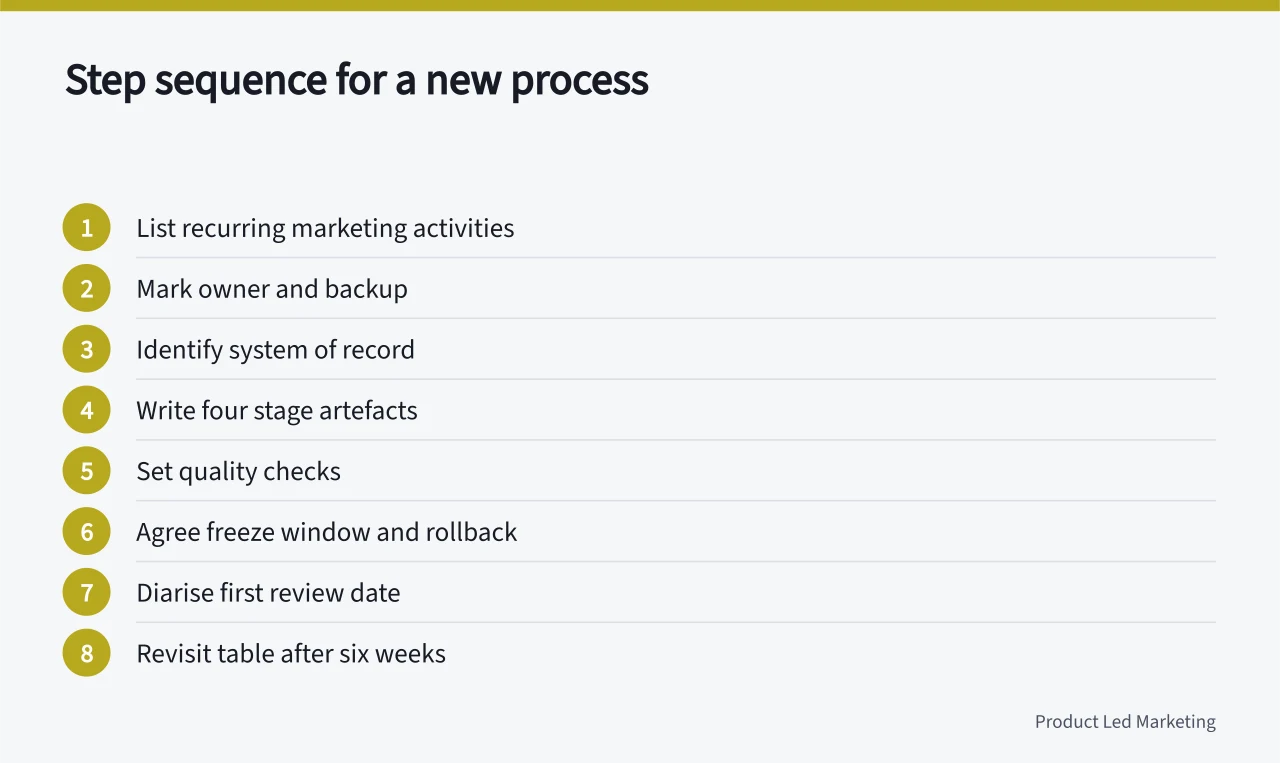
Run the sequence against a live campaign rather than a hypothetical one. Real work exposes the gaps that a template hides, and the first pass almost always changes the ownership table.
Do not run this as a project with a steering group. Run it as an edit to how work already happens. Large process programmes in small SAAS firms rarely finish.
Launch discipline
A launch is a dated event with a named owner, a checklist and a stop rule. The stop rule is the part teams forget.
Pre-launch checks
- Tracking works
- Forms route to monitored inbox
- Landing page renders on phone
- Ad claim matches page claim
- Freeze window agreed
- One person allowed to break freeze
Before launch, confirm tracking works, forms route to a monitored inbox, and the landing page renders on a phone. Confirm the claim in the ad matches the claim on the page. Mismatches waste spend and create complaints.
Paid social boosting should follow the platform's own guidance rather than habit, so check the current advice on boosting posts on LinkedIn before extending reach on an organic post. The same discipline applies to search campaigns, where the platform's published Google Ads best practices cover budget, targeting and measurement settings worth reviewing each quarter.
If you are launching a new domain or a campaign microsite, the rules for crawler access belong in the launch checklist. The robots.txt specification explains how directives are read, which prevents an accidental block on a paid landing page.
Agree the freeze window before the launch date, not on the day. Most teams freeze changes to tracking and forms for 48 hours either side, which keeps test results readable. Record the window and name the one person allowed to break it.
After launch, one person watches the first 48 hours. That person has authority to pause. A launch record notes the date, the owner, the spend and the pause decision.
Quality checks and evidence
Quality checks should be short enough to run every time. Ten checks beat a fifty-page manual nobody opens.
Keep the checks in one place and version them. When a check changes, note why. The SAAS marketing launch review: data and sources piece shows how to tie review evidence back to the original brief.
Evidence matters beyond internal reporting. If your SAAS product handles personal data, or uses AI features, the ICO guidance on artificial intelligence sets out data protection expectations that marketing claims and consent flows must not contradict.
If you sell into financial services, your buyers will ask about regulatory posture. The Financial Conduct Authority is the regulator for that sector, and its published rules shape what fintech buyers can accept from suppliers.
In-house or agency
In-house teams keep product knowledge and move quickly on small changes. Agencies add capacity and specialist skills without a permanent hire.
In-house versus agency split
In-house
- Strategy
- Owns
- Positioning
- Owns
- Product marketing
- Owns
- Production
- Supports
- Paid media execution
- Supports
- Specialist design
- Supports
Agency
- Strategy
- Supports
- Positioning
- Supports
- Product marketing
- Supports
- Production
- Owns
- Paid media execution
- Owns
- Specialist design
- Owns
The split usually follows the work. Strategy, positioning and product marketing sit in-house. Production, paid media execution and specialist design often sit with an agency.
Cost shape differs from cost size. A mid-level in-house marketing manager on a typical UK salary of £40,000 to £55,000 costs about £210 to £290 a day once employer National Insurance and pension contributions are added. That assumes roughly 220 working days a year.
A freelance specialist on comparable work typically quotes £350 to £550 a day. A retained agency covering strategy, execution and design is commonly quoted from around £3,000 a month. Scope, seniority and notice period set the final number, so ask for a day rate before comparing totals.
Set the boundary in writing. Say which team owns the brief, which owns the asset, and which owns the number. Ambiguity here causes most agency disputes.
Review the split every two quarters. A SAAS company at ten staff needs a different mix from one at eighty. Service expectations for suppliers are set out in the SAAS marketing service standards in England article, which is worth reading before renewing a retainer.
Where an agency is used, demand the same artefacts as an internal team: brief, asset pack, launch record, review note. The format does not change because the work is external.
Tools, the data dictionary and reporting
Every metric needs one system of record. If two dashboards disagree, pick one and retire the other.
Data dictionary fields
- Field name
- Definition
- Source
- Owner
Name the platforms the team actually uses. CRM: HubSpot, Pipedrive or Salesforce. Analytics: Google Analytics 4, Plausible or Mixpanel. Ad platforms: Google Ads, LinkedIn Ads or Microsoft Advertising. One per category, written into the ownership table.
Name the reporting cadence: weekly for campaign health, monthly for channel performance, quarterly for budget. Each report has an owner and a reader. A report with no reader should be deleted.
Keep a simple data dictionary with four columns:
| Field | Definition | Source | Owner |
|---|---|---|---|
| Marketing qualified lead | Contact who requested a demo and matches the agreed customer profile | HubSpot | Data owner |
| Conversion rate | Demo requests divided by site sessions, per week | Google Analytics 4 | Data owner |
| Cost per lead | Paid spend divided by qualified leads, per channel | Google Ads plus CRM | Paid media manager |
| Pipeline influenced | Open deals with at least one marketing touch | Salesforce | Head of demand |
Ten lines is enough for most SAAS marketing teams.
Tool sprawl causes most disagreement about numbers. Every added platform creates another place where a figure can drift. Before buying, ask which existing tool the new one replaces.
Audit tracking after any site change. A misplaced tag can silently halve reported conversions, and the error usually surfaces at quarter end when it is expensive to fix.
ICO, FCA and the compliance register
Marketing operations carry three recurring risks: wasted spend, data errors and unsupported claims.
Wasted spend is controlled by the stop rule and a weekly budget check. Unsupported claims are controlled by review before publication. Data errors are caught by the quality checks before launch.
Personal data and AI sit under UK GDPR. The ICO guidance linked above is the reference point for England, Scotland, Wales and Northern Ireland, and it covers drafting tools and audience scoring as much as consent flows.
If you sell into financial services, the FCA rules belong in the same review. Its published rules shape what fintech buyers can accept from suppliers, so evidence for accuracy, performance and security claims belongs in the pack before launch.
Keep a one-page register with five columns. Sample rows show the format:
| Tool or claim | Data touched | Lawful basis | Approving owner | Review date |
|---|---|---|---|---|
| Drafting assistant | Internal notes only | Not applicable | Content lead | End of week one, each block |
| Audience scoring model | CRM contact records | Legitimate interests | Data owner | End of week one, each block |
| Claim: bank-grade security | None | Not applicable | Head of demand | Before each launch |
When a claim is questioned months later, the register answers faster than any dashboard.
Reviewing and improving
Review is where operations earn their keep. Hold one meeting per six-week block, with the launch records in front of you.
Review meeting questions
- What did we promise?
- What happened?
- What changes next block?
Ask three questions. What did we promise? What happened? What changes next block? Keep the answers to one page.
Review meetings drift into status updates unless someone holds the line. Put decisions on the agenda: what stops, what continues, and what changes before the next block.
Track two or three operational measures, such as launches shipped on the planned date, checks completed before launch, and review notes written. These measures improve delivery without needing a new dashboard.
Direction of travel matters for planning. The SAAS marketing trends and outlook for England in 2027 piece covers the shifts likely to affect budgets and channel mix, which is useful input to the next six-week block.
Common questions
Who should own SAAS marketing operations?
Usually a marketing lead or operations manager with authority to stop a launch. In teams under ten people it is often the same person who owns demand generation. What matters is that the name is written down and known to sales.
How often should the process be reviewed?
Every six weeks, alongside the launch review. A full ownership table review once a quarter is enough unless the team changes size or a major tool is replaced.
Do agencies need to follow the same process?
Yes. Ask for the same four artefacts and the same checks. If a supplier cannot produce a launch record, that is a signal about how they work, not a paperwork preference.
What if the team has no capacity to build this?
Start with the ownership table only. It takes half a day and removes most handover failures. Add the artefacts and checks in the following block.
In this guide
- Why a SAAS marketing operating workflow needs owners, not toolsHow to build a SAAS marketing operating workflow with named owners, weekly reviews and handover rules, plus a one-page checklist your team can run.
- Eight checks for a SAAS marketing quality checklistA working checklist for SAAS marketing quality: robots.txt access, cookie consent, LinkedIn boosting and the QA steps that stop small errors reaching revenue.
- SAAS marketing team roles and their data sources explainedA listicle mapping the data sources behind common SAAS marketing team roles, with inclusion criteria, a comparison table and UK compliance links.
- How do I set and audit SAAS marketing service standards?Set measurable SaaS marketing service standards, score suppliers with a weighted rubric and audit delivery against evidence before renewal.
- When to run a SAAS marketing launch review on data and sourcesSaaS marketing launch reviews: when to run them, which data sources to audit, and how to check claims, tracking and data handling before and after launch.