

Costs and pricing
SAAS marketing hidden costs often arrive after the contract is signed
A listicle of the SAAS marketing hidden costs finance teams in England should budget for, with a scoring rubric and sources behind each figure.
What to take away
- Hidden costs in SAAS marketing arrive after signatureproduction, measurement, third-party access.
- Price each one and name an owner before the quarter closes.
- Recurring charges beat one-offs because they compress next year's budget.
- Apply England rules where customers and staff sit, then check the rest of the UK.
- Figures are illustrative unless a named vendor publishes its own.
What qualifies for this list
Inclusion criteria and geography
An item earns a place if a SAAS marketing plan creates an invoiceable cost it never names in advance. Recurring charges rank above one-offs, and the list covers England.
Scoring rubric for each item
Criterion
- Likelihood
- How often does it land?
- Monthly value
- What to set aside monthly?
- Lock-in
- How hard to cancel?
- Ownership
- Who checks and pays?
- Evidence
- Can you show the work?
Question
- Likelihood
- 1 yearly, 5 monthly
- Monthly value
- 1 under £100, 5 over £2,000
- Lock-in
- 1 monthly notice, 5 annual term
- Ownership
- 1 named person, 5 unclear
- Evidence
- 1 yes, 5 no
Score 1 to 5
- Likelihood
- Monthly value
- Lock-in
- Ownership
- Evidence
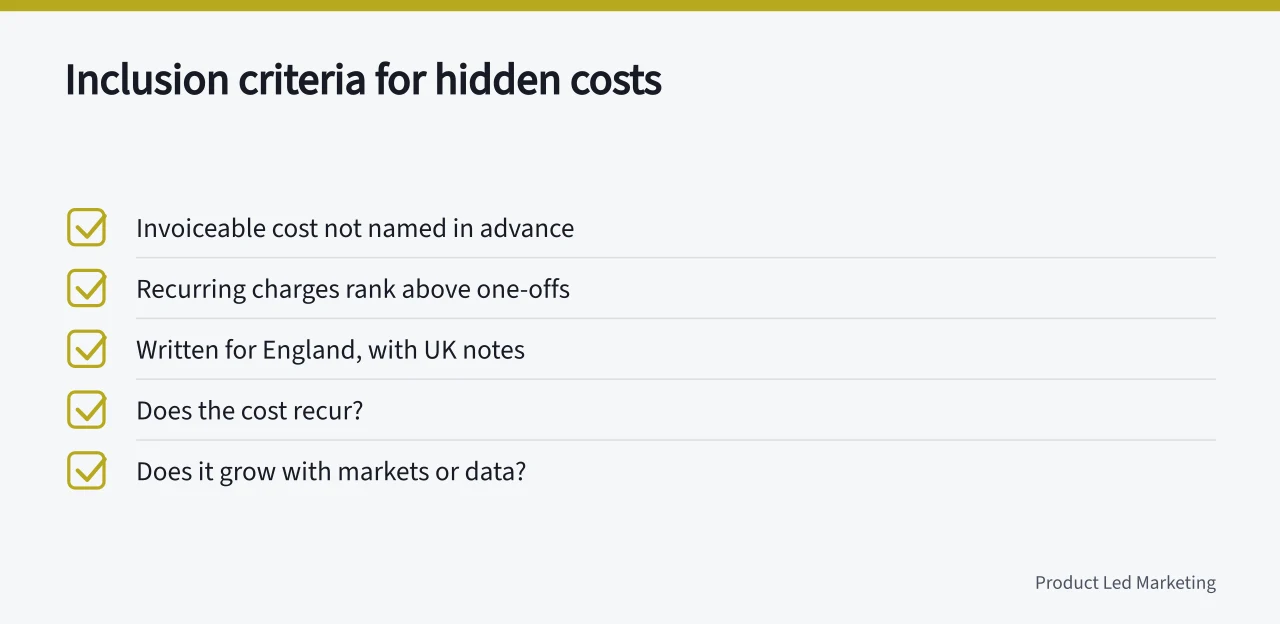
Two filters decide: does it recur, and does it grow with each new market or data source? Media spend is excluded because it is approved line by line.
Scoring each item
Score before you approve: the rubric keeps finance talks factual.
| Criterion | Question to ask | Score 1 to 5 |
|---|---|---|
| Likelihood | How often does it recur? | 1 = yearly, 5 = monthly |
| Monthly value | What would you set aside each month? | 1 = under £100, 5 = over £2,000 |
| Lock-in | How hard is it to cancel? | 1 = monthly notice, 5 = annual term |
| Ownership | Who owns the invoice? | 1 = named person, 5 = unclear |
| Evidence | Can you show the work it supports? | 1 = yes, 5 = no |
Rank totals rather than single scores. Above 15, a charge needs an owner, a monthly check and a rerun before hiring.
Worked example: a review platform seat costs £150 a month. Scores: likelihood 5, monthly value 2, lock-in 4, ownership 5, evidence 3. Total 19. Action: assign a named owner, check monthly, rerun before hiring.
The SAAS marketing costs and budget guide for England groups spend into categories you can defend in a board pack.
Creative and content production at volume
Campaign assets bill one at a time: copy, imagery, video edits, landing page variants and translations.
Design seats add up: Figma charges per editor, typically around £10 to £15 a month on Professional. Envato Elements is about $16.50 a month for unlimited stock downloads.
Each market adds a review cycle and a native-language check. IAB UK publishes principles for native distribution creative best practice, the benchmark for sponsored content beside editorial.
Volume is where the surprise lives: eight assets a month at £250 each is £2,000 monthly, or £24,000 a year.
Localisation sits on top: a native check per market, then a second pass when a name or claim changes. Typical rates run from about 8p to 15p a word.
Measurement, tagging and consent
A clean implementation needs a developer, a quality check and maintenance when templates change. Google Analytics 4 is free on its standard tier, capped at 10 million events a month.
Google's documentation on measuring pageviews shows how much sits on that one recorded action, and errors pass downstream.
Consent tooling adds a licence plus a review whenever guidance or vendor terms shift. Cookiebot and CookieYes price per domain, with entry tiers typically under £15 a month.
An illustrative developer day at £450, repeated twice a year, is a common shape. Freelance rates in England typically run £400 to £600 a day.
Data, list and third-party access
Enrichment, review platforms and research panels bill per seat or per record. Semrush publishes Pro at $139.95 a month and Business at $499.95 per account. Apollo.io lists Basic at $49 per user a month.
Three users absorb that easily; nine users during a hiring round can double the invoice.
Research panels bill per completed response: Prolific pays participants a recommended £9 an hour, with £6 the floor, plus a platform fee.
Seat-based pricing punishes success: a better campaign means more people need reporting access.
Sources and citations
| Source | Figure or reference |
|---|---|
| Figma Professional | typically £10 to £15 per editor a month |
| Envato Elements | about $16.50 a month |
| Google Analytics 4 | free on standard tier, capped at 10 million events a month |
| Cookiebot and CookieYes | per domain, entry tiers typically under £15 a month |
| Semrush | Pro $139.95 a month, Business $499.95 per account |
| Apollo.io | Basic $49 per user a month |
| Prolific | recommended £9 an hour, £6 floor, plus platform fee |
| England freelance rates | typically £400 to £600 a day; illustrative developer day £450 |
| Auto-enrolment | employer pension contributions 3% of qualifying earnings |
| IAB UK | principles for native distribution creative best practice |
| ONS | investments, pensions and trusts data |
Contractor and tooling administration
Contractors bill for onboarding and handover, and the internal hours spent briefing and paying them rarely appear in a budget. Off-payroll rules apply where the client is medium or large; small companies are exempt.
Set a threshold, for example £200 a month, above which every subscription needs a named owner.
Where staff sit in Scotland, Wales or Northern Ireland, confirm contract and payroll paperwork before standardising it. Auto-enrolment sets employer pension contributions at 3% of qualifying earnings.
A cost that supports one channel should clear its own test. The SAAS marketing return on investment in England article explains how.
Recurring versus one-off hidden costs
| Hidden cost | Type | Indicative monthly | Indicative annual |
|---|---|---|---|
| Creative production (8 assets at £250) | Recurring | £2,000 | £24,000 |
| Localisation per market | Recurring | £150 to £600 | £1,800 to £7,200 |
| Consent tooling per domain | Recurring | under £15 | under £180 |
| Data and list seats | Recurring | £100 to £300 | £1,200 to £3,600 |
| Measurement and tagging developer (2 days at £450) | One-off | not monthly | £900 |
| Contractor onboarding and handover | One-off | not monthly | £400 to £1,200 |
| Research panels per completed response | One-off | not monthly | £500 to £2,000 |
For a mid-size England SaaS team, the overall indicative hidden-cost range is about £29,000 to £39,000 a year. Recurring charges are roughly £27,000 to £35,000 of that; one-offs add about £2,000 to £4,000.
Common questions
Which hidden cost should finance see first?
The one with the longest lock-in and the least obvious owner. A recurring charge nobody manages grows quietly.
How do I estimate a cost before I have a quote?
Use the rubric, then ask a supplier for a written range. Record the assumption next to the number.
Does geography change this list?
The categories fit teams selling into the UK. Consent wording, contract terms and employer obligations differ in Scotland, Wales or Northern Ireland.
How often should the rubric be rerun?
Once a quarter, or before any hiring round that adds seats to paid tools. Headcount-driven costs move fastest.